
Event Information
Date
November 19th, 2026
Time
12:00pm - 1:00pm
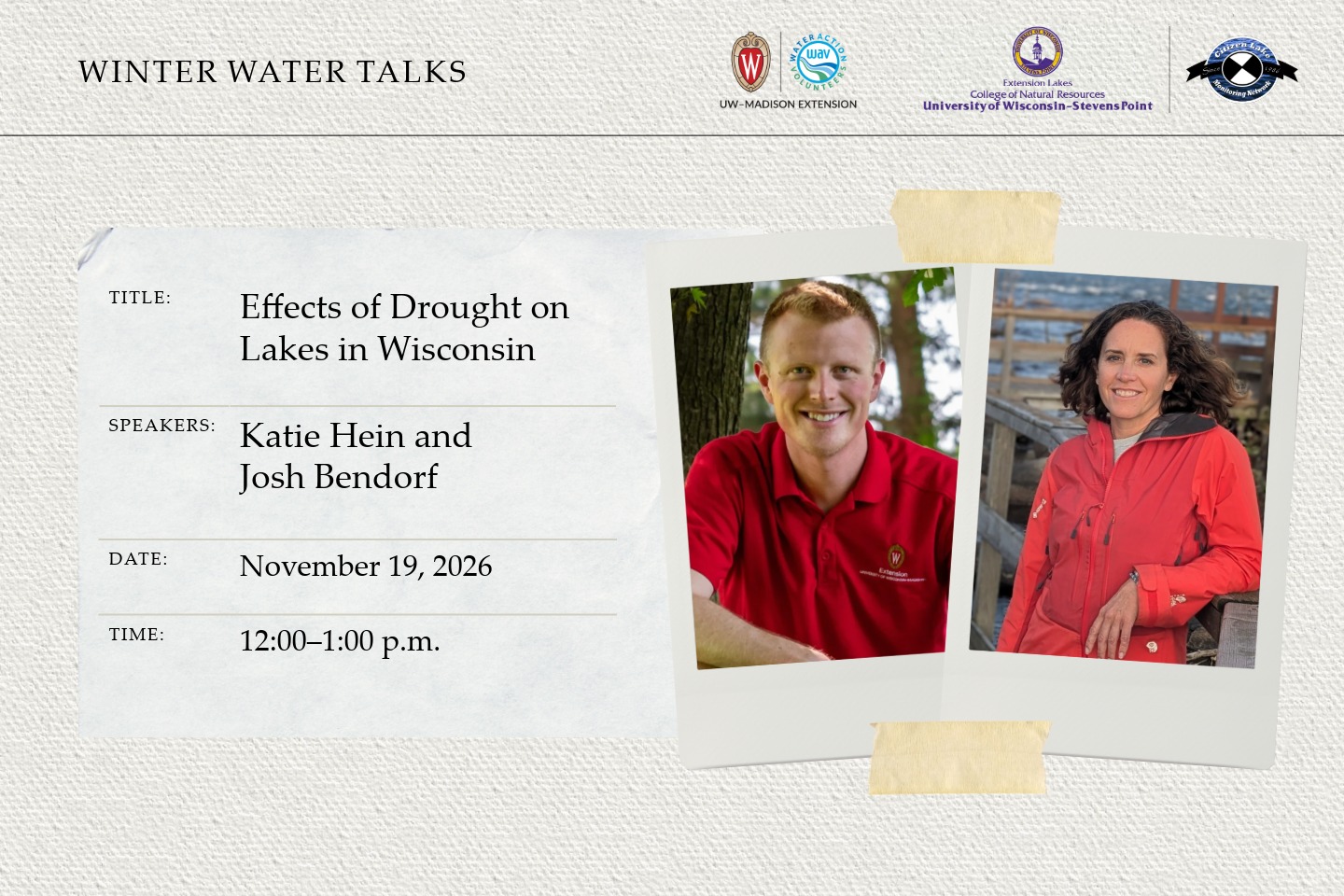
Winter Water Talks is a series of free online webinars hosted by the Water Action Volunteers (WAV) program and the Citizen Lake Monitoring Network. This winter learning series is open to the public and focuses on a variety of lake and stream topics, including water quality, weather and climate, watershed health, aquatic animals and plants, and more!
Description
A Recap and Future Outlook for Wisconsin’s Current Drought with Josh Bendorf
In 2026, drought developed across northern Wisconsin during the second half of the summer into early fall, reaching extreme to exceptional levels on the U.S. Drought Monitor by autumn. For some counties in the North, the summer of 2026 ranked as one of the top 10 driest of all-time. The first part of the webinar will cover the climatological conditions that led to our current drought status in Wisconsin and take a look at precipitation and drought outlooks for the upcoming months.
Effects of Drought on Lakes from Short-term and Long-term Perspectives with Katie Hein
Drought can affect lakes in many ways beyond lowering water levels. Lower water levels can temporarily dry out fish spawning habitat, while creating new opportunities for native plants like bulrushes to sprout and grow. Wisconsin lake levels naturally rise and fall roughly every ten years, making drought a normal, healthy part of a lake’s long-term cycle.
Speakers
Josh Bendorf
UW—Madison, Wisconsin State Climatology Office
Josh’s primary role with the State Climatology Office is to work with the UW–Madison Division of Extension to conduct outreach programming that will increase the understanding of Wisconsin’s climate and the impacts of climate on Wisconsin residents.
He earned a bachelor of science in atmospheric and oceanic sciences from UW–Madison and a master of science in agricultural meteorology from Iowa State University. Josh worked for Pheasants Forever as a conservation specialist and as an Agricultural Climatology Fellow at the USDA Midwest Climate Hub before joining the office. In his free time, Josh enjoys being active and being outdoors.
Katie Hein
UW—Madison, Trout Lake Station
Katie Hein is a research scientist at UW–Madison Trout Lake Station and has been studying lake levels in Wisconsin for over a decade. She has a master’s degree in limnology from UW–Madison and a doctorate in aquatic ecology from Utah State University. Previously, she worked as an assistant professor at Umeå University in Sweden and as a lake monitoring leader for the Wisconsin Department of Natural Resources.
Date and Time:
Thursday, November 19
12:00 p.m. to 1:00 p.m.
Registration:
Nov. 19 | Winter Water Talks Registration
Location:
Virtual (Zoom)
Cost:
Free